What Is Fucoidan Sulfate?
The Role of Sulfate Groups in Fucoidan Structure
The sulfate group found in fucoidan is a sulfur-containing component that plays a crucial role in its structure and function. Although sulfuric acid itself is known as a strong substance, it becomes non-toxic when bonded with organic compounds. In this bonded state, it is referred to as a “sulfate group.”
Why Sulfate Groups Are Essential for Fucoidan’s Health Properties
Minimum Sulfate Binding Required for Effectiveness
Scientific studies have shown that sulfate groups are deeply involved in the health-supporting properties of fucoidan. To maintain these functions, fucoidan should retain a sulfate group binding level of at least 13%. Therefore, extraction methods that preserve sulfate groups are essential when producing high-quality fucoidan.
Unique Characteristics of Sulfated Fucoidan
Fucoidan is primarily composed of sugars such as fucose, galactose, xylose, and uronic acid. What distinguishes fucoidan from many other polysaccharides is its high sulfate group content. Sulfate groups have a strong ability to retain moisture, creating a viscous, gel-like texture that protects seaweed surfaces.
Within the human body, this same property helps support protective functions and contributes to overall health.

Compatibility with the Human Digestive System
Sulfate groups are structurally similar to the viscous components found in the human gastric mucosa. When fucoidan reaches the stomach, it blends naturally with the body’s mucous substances, allowing for smooth interaction.
Differences Among Seaweeds and the Importance of Mozuku
There are several types of fucoidan depending on the species of seaweed, each with a slightly different structure. Recent research indicates that mozuku seaweed, which contains abundant viscous components, is especially suitable for health-related applications.
Mozuku contains approximately five to eight times more fucoidan than many other seaweeds and is particularly rich in sulfated fucose.
Key Points When Choosing Fucoidan Products
When selecting a fucoidan product, it is important to confirm both the sulfate group content and the sulfate binding ratio. Choosing a manufacturer that clearly discloses numerical values and analysis results ensures product transparency and reliability.
Learn more about fucoidan products here
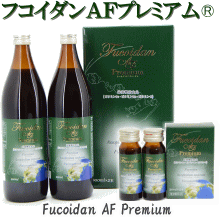
Fucoidan AF Premium



 900ml Liquid
 Capsule
 Trial Set
 30ml Liquid
Fucoidan
- What is fucoidan?
- What is fucose?
- What is sulfate group?
- Ingesting fucoidan from food
- Choose Fucoidan products
- Frequently Asked Questions (FAQ)
Fucoidan AF Premium
- Why It Is Chosen
- Fucoidan Ingredients
- Fucoxanthin Ingredients
- Ascophyllum Ingredients
- Amino Acid Ingredients
- Trusted Safety
- Credibility and Quality You Can Trust
- Compared with low molecular fucoidan
- Difference with Nano Fucoidan
- How to drink・Storage instructions
Fucoidan Kenkodo
Official SNS


Catalog
Fucoidan AF Premium
Message from Health Advisor

A Certified Health Management Advisor supports health from a perspective different from that of medical doctors. Their role includes planning environments, physical well-being, and lifestyles that help prevent illness before it occurs, as well as sharing accurate knowledge to maintain and promote health. They also engage in health management activities in daily life and work to protect people’s health in businesses, local communities, and households.By providing information to help reduce health issues related to lifestyle habits, we hope to support and empower you to enjoy each day with a smile.
SHOP INFO
Fucoidan Kenkodo
2-8-1 Kasugabaruhigashimachi, Kasuga-shi, Fukuoka 816-0801, Japan
TEL 0120-251-334
(Toll-free number within Japan only)
Business hours: 9:00 AM–9:00 PM JST
For international calls: +81-92-588-5775
 LOHAS Co., Ltd. is a "Fukuoka Prefecture Childcare Support Declaration Company." Fukuoka Prefecture No. 16 LOHAS Co., Ltd. is a "Fukuoka Prefecture Childcare Support Declaration Company." Fukuoka Prefecture No. 16 |
